Saadat Hasan Khan passed his dissertation proposal defense on November 9, 2026. His dissertation, Reliable Language-Model Question Answering for High-Stakes Medical Decision Support, covers three studies: DF-RAG (Findings of EACL 2026), on retrieval; a knowledge distillation pipeline for checking health information sources (PLOS Digital Health 2026); and EPI-MEDQA, a benchmark for how language models weigh hypotheses in medical questions. Congratulations, Saadat!
Md defends his dissertation and joins Amazon as an Applied Scientist
Md. Mushfiqur Rahman defended his PhD dissertation, Advancing Natural Language Processing Evaluation Methods for Improving Accessibility and Safety of Health Communication Systems, on October 28, 2026. The dissertation asks whether health language models serve every patient and hold up against a determined adversary, and answers with four studies: SimpleDC, an expert-annotated benchmark and training method for simplifying patient materials; an evaluation showing that answer quality drops when the same health question is phrased in a different style; ATTCK-R, a multi-turn attacker for protected models; and HealthJailbreak, a red-teaming benchmark for health chatbots, paired with policy-swap DPO, a training method that follows whatever scope and safety policy a deployment specifies. Kevin Lybarger directed the dissertation, with Ziwei Zhu as co-advisor and Amarda Shehu and Antonios Anastasopoulos on the committee. Md has already started at Amazon as an Applied Scientist II in Seattle. Congratulations, Dr. Rahman; the whole lab is excited for him.
Kevin to teach in Mason’s Chief Data and AI Officer program
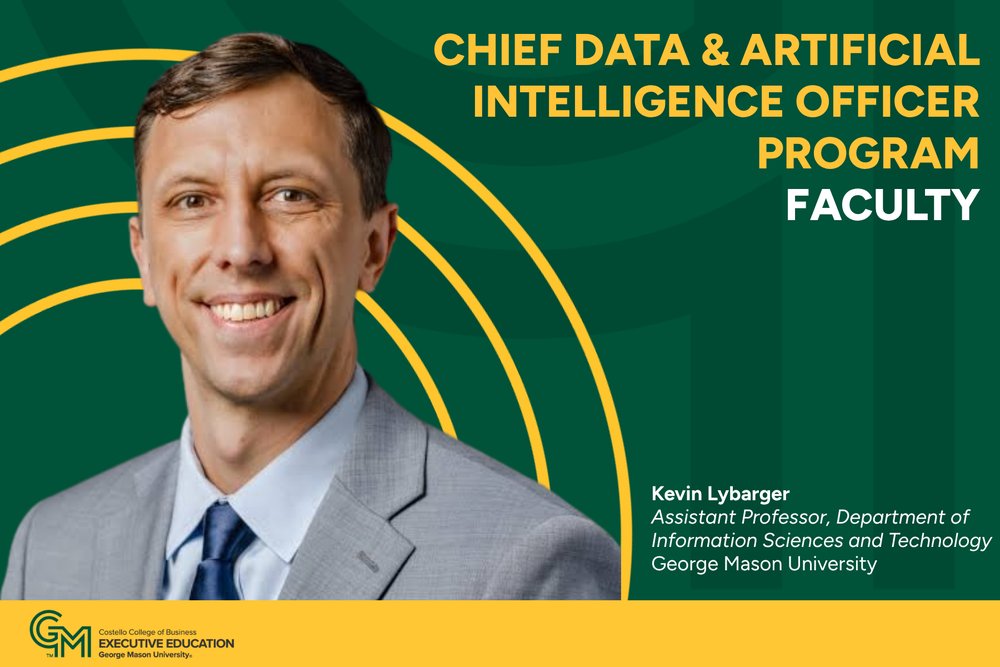
Kevin Lybarger will teach the session on large language models, retrieval-augmented generation (RAG), and agentic AI in the next cohort of the Costello College of Business’s Chief Data and AI Officer program, which runs February to May 2027. The executive education program is for current and aspiring senior leaders who set their organization’s data and AI strategy. Program details and registration (image courtesy of Costello College of Business Executive Education).
DEMI causal prediction paper published in the Journal of Biomedical Informatics
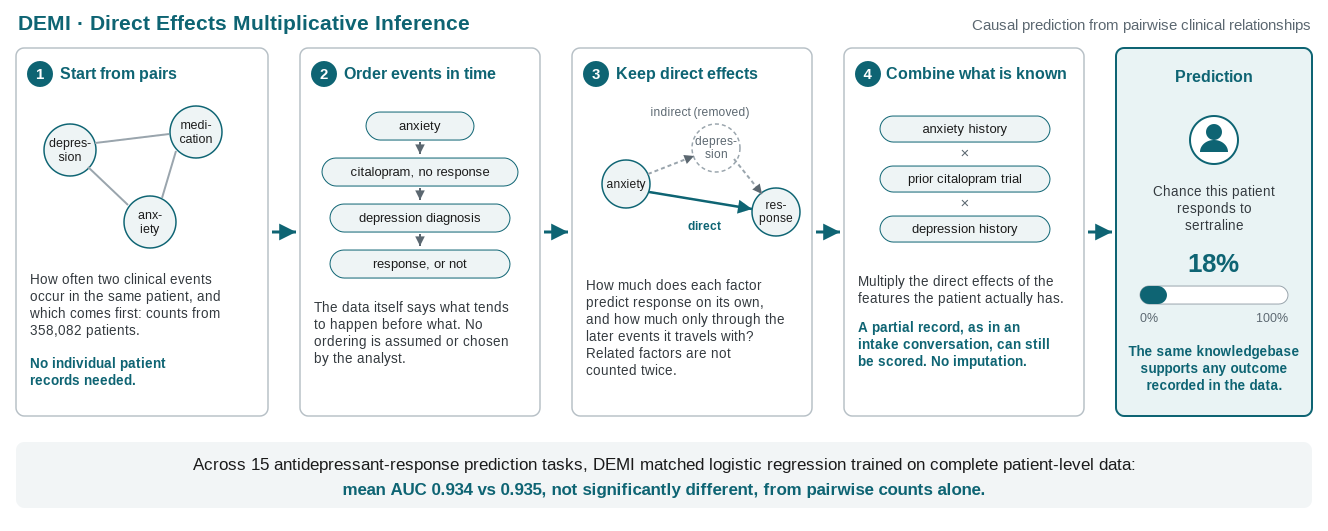
Farrokh Alemi, Yili Lin, Hadeel Elyazori, Vladimir Franzuela Cardenas, Niloofar Ramezani, and Kevin Lybarger published “Direct Effects Multiplicative Inference (DEMI)” in the Journal of Biomedical Informatics, part of the lab’s depression AI work. DEMI predicts patient outcomes from counts of how often pairs of clinical events occur in the same patient and which comes first, so it needs no individual patient records and can score a partial record, such as one gathered in an intake conversation. Across 15 antidepressant-response prediction tasks, it matched logistic regression trained on complete patient-level data (mean AUC 0.934 vs. 0.935). Read the paper free until December 16, 2026, or through its DOI (graphical abstract from the paper; select it to open full size).
ATTCK-R jailbreaking paper published in Findings of EMNLP 2026
Md. Mushfiqur Rahman's paper with Tobias Rohde, Rahul Tripathi, Khalil Elkhalil, and Kevin Lybarger appears in Findings of EMNLP 2026. ATTCK-R treats multi-turn jailbreaking of a protected language model as a long-horizon planning problem. It keeps a structured belief state across turns, builds a library of tactics from earlier successes and failures, and resumes from useful intermediate states instead of restarting, and it outperformed recent multi-turn frameworks against nine widely used LLMs, each behind a prompt-based safety layer. The paper also shows that a single safety layer sharply lowers a strong baseline's success rate, so evaluations against unprotected models overstate real-world vulnerability. Read the paper.
PCORI depression AI project presented at the Congressional Science Fair
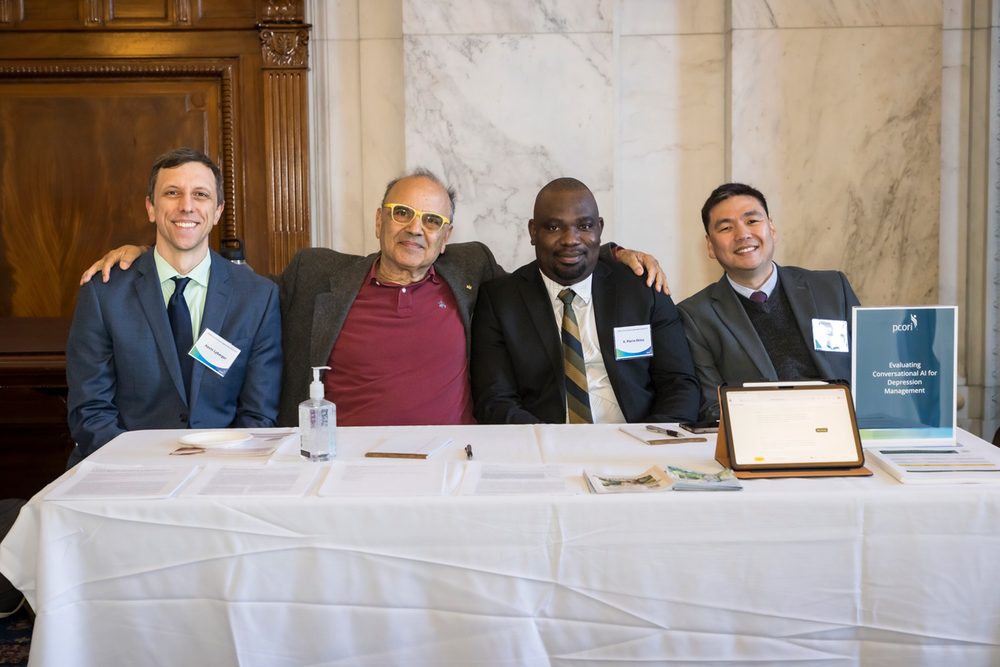
Kevin Lybarger, Farrokh Alemi, K. Pierre Eklou, and Vladimir Franzuela Cardenas presented Evaluating Conversational Artificial Intelligence for Depression Management at PCORI's fourth annual Congressional Science Fair on October 21, 2026. The fair, held in the Kennedy Caucus Room of the Russell Senate Office Building, brought teams from 29 PCORI-funded studies and projects to Capitol Hill to talk with congressional staff about their work. The team showed a video of an example conversation with the system. (Photo courtesy of the Patient-Centered Outcomes Research Institute® (PCORI®).)
Clinical NLP chapter published in the Springer Handbook of Data Engineering
Kevin Lybarger, Hadeel Elyazori, and Mohammad Sabik Irbaz wrote “Natural Language Processing of Clinical Data” with Özlem Uzuner, Giridhar Kaushik Ramachandran, and A. H. M. Rezaul Karim for the Springer Handbook of Data Engineering, edited by Fatos Xhafa. The chapter, a primer on clinical NLP, covers clinical documents and annotated datasets, data quality and privacy challenges, and methods from rule-based systems to large language models, and explains how to frame clinical problems as NLP tasks. Read the chapter (image courtesy of Springer).
Tanvir's patient simulation paper published in JMIR AI
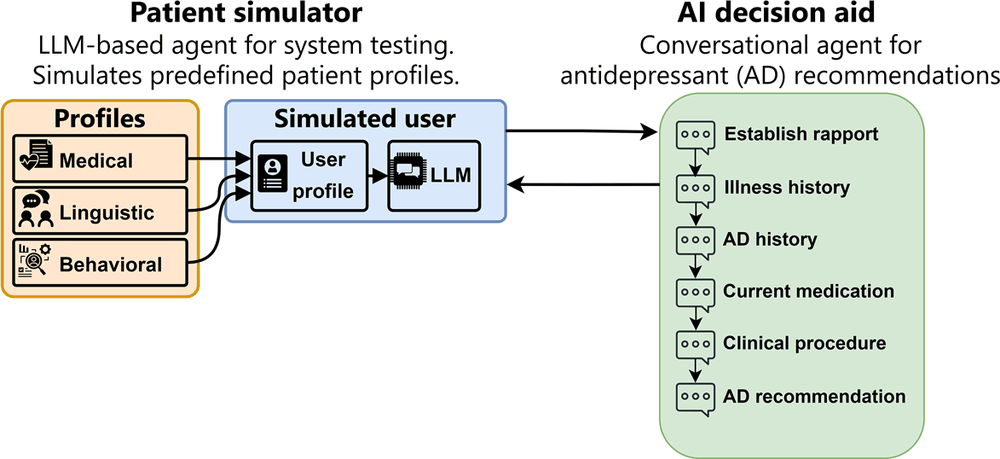
Md Tanvir Rouf Shawon's paper with Mohammad Sabik Irbaz, Hadeel Elyazori, and collaborators is now published in JMIR AI. It describes a framework for testing conversational health AI before deployment by simulating patients who differ in medical history, health literacy, and conversational behavior. Applied to a decision aid for antidepressant selection, the simulations showed the aid ranked the correct clinical concept first 82% of the time for patients with proficient health literacy and 48% of the time for patients with limited health literacy. Read the paper (figure from the paper).
Hadeel to join healthcare access panel at Mason
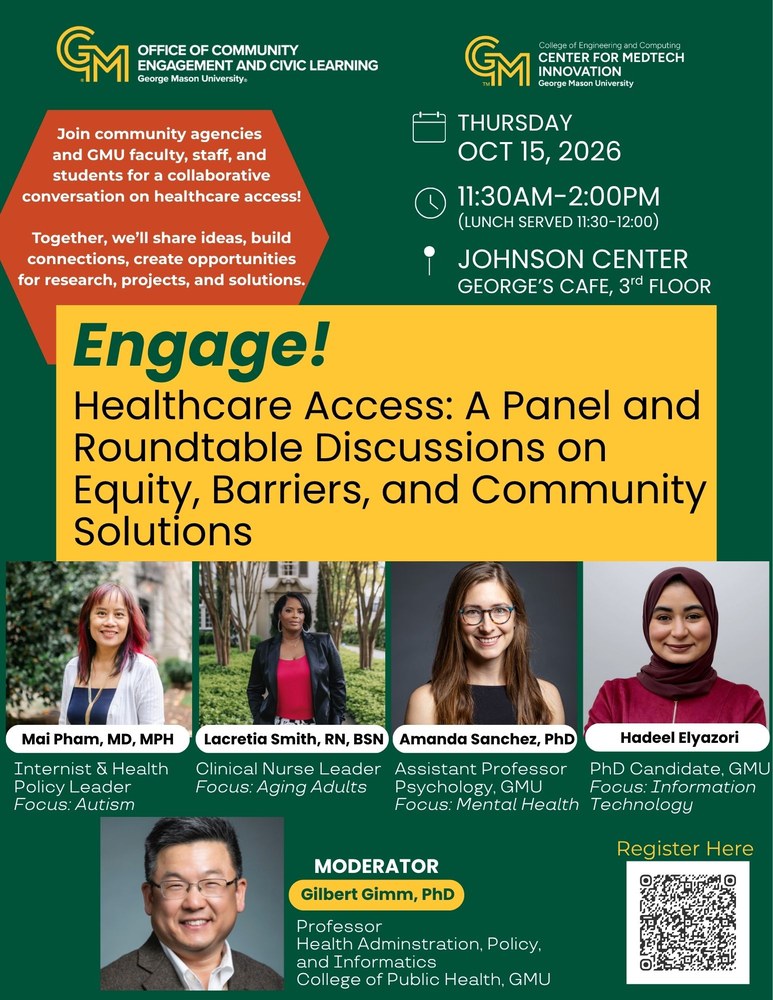
Hadeel Elyazori will join a panel on healthcare access across diverse populations, alongside Hoangmai Pham (Institute for Exceptional Care), Lacretia Smith, and Amanda Sanchez, moderated by Gilbert Gimm. Hosted by George Mason's Office of Community Engagement and Civic Learning (CECiL) and the Center for MedTech Innovation, the panel and roundtable run 11:30am–2:00pm on October 15, 2026, at the Johnson Center's George's Café. Register.
Tanvir's paper accepted in JMIR AI
Congratulations to Md Tanvir Rouf Shawon on the acceptance of his paper on Patient Simulation in JMIR AI.
Hadeel passed her comprehensive exam
Congratulations to Hadeel Elyazori on passing her comprehensive exam.
PCORI award to improve depression treatment using AI
Dr. Alemi and Dr. Lybarger received a $1,049,998 award from the Patient-Centered Outcomes Research Institute (PCORI) for their 3-year project, Evaluating Conversational Artificial Intelligence for Depression Management. The project explores applications of large language models to improve antidepressant recommendations and patient outcomes. Details on the PCORI website and the GMU website.
NIH grant to pilot AI chatbot for African Americans with depression
George Mason University's College of Public Health received a $70,906 NIH AIM-AHEAD grant to develop and test an AI chatbot that recommends antidepressants for African Americans with depression, aiming to address gaps in personalized treatment. Details in the George Mason announcement.
n2c2 SDOH extraction challenge paper published in JAMIA
The paper describing the National NLP Clinical Challenges (n2c2) extraction task, Track 2: Extracting Social Determinants of Health, was published in JAMIA. Challenge participants used a wide range of innovative techniques.
JAMIA focus issue on extracting SDOH
The Journal of the American Medical Informatics Association published a call for papers for a focus issue, Social Determinants of Health (SDOH) Extraction through Natural Language Processing, with submissions due in early December.
AMIA work exploring digital scribes and transcribed patient visits was featured in an article by Fierce Healthcare.
Talk at the UW Center for Studies in Demography & Ecology
Kevin Lybarger presented his social determinants of health research to the UW Center for Studies in Demography & Ecology on November 5, 2021.
AMIA presentations
At the AMIA Virtual Day on October 26, 2021, Kevin Lybarger presented a paper on automatic identification of acute respiratory distress syndrome (ARDS) in chest radiograph reports (paper) and a poster on applying information extraction models to transcribed patient visits.
 Lybarger